
informational 6 min read
Scipione Borghese: The Cardinal Behind the Borghese Gallery
Updated October 27, 2026
Cardinal Scipione Borghese (1577-1633) was the nephew of Pope Paul V and the man who built the Villa Borghese and most of its collection. He commissioned Bernini’s great marble groups, collected Caravaggio, Titian and Raphael, and planned the villa outside Porta Pinciana as a showcase for them. The state bought the villa and collection in 1902, and they make up the Borghese Gallery you visit today.
The Borghese family and Pope Paul V
The Borghese came to Rome from Siena, according to the museum. Their rise peaked in 1605, when Camillo Borghese was elected pope as Paul V. He reigned until 1621 and launched major building and collecting projects in the city.
Scipione was born on 1 September 1577 in Artena, south of Rome. His father was Francesco Caffarelli and his mother Ortensia Borghese, the pope’s sister. Known as Scipione Caffarelli Borghese, he carried his mother’s family name, and Paul V made him a cardinal on 18 July 1605.
As cardinal nephew, Scipione ran much of the papal state’s politics and diplomacy. He held a long list of offices, including:
- Librarian of the Holy Roman Church
- Grand Penitentiary (1610-1633)
- Archbishop of Bologna (1610-1612)
- Archpriest of the Lateran and Vatican basilicas
The posts brought large incomes. Wikipedia puts his yearly income at about 90,000 scudi in 1609 and about 140,000 scudi by 1612, and he spent much of it on buildings, land and art.
He died in Rome on 2 October 1633 and is buried in the Borghese chapel of Santa Maria Maggiore.
Scipione as patron of Bernini and Caravaggio
Scipione did not always collect by buying. Three episodes show how:
- 1607: Paul V handed him 107 paintings seized from the painter Cavalier d’Arpino over an unpaid tax bill. Among them were two early Caravaggios, Boy with a Basket of Fruit and the Sick Bacchus, both now in Room 8.
- 1608: Raphael’s Deposition was removed from the Baglioni Chapel in Perugia and taken to Rome by papal order. Perugia got copies, and the original hangs in Room 9.
- 1608: Titian’s Sacred and Profane Love probably came to him with a group of paintings from Cardinal Paolo Emilio Sfondrati, though the museum notes that this account is uncertain.
Caravaggio. The museum says the cardinal owned twelve Caravaggios. Six are still in Room 8, the Silenus Room: the two early pictures above, plus Saint Jerome, the Madonna of the Palafrenieri (Madonna and Child with Saint Anne), Saint John the Baptist and David with the Head of Goliath.
Bernini. Between 1618 and 1625 the young Gian Lorenzo Bernini carved a run of marble groups for him:
| Work | Date | Where it is now |
|---|---|---|
| Aeneas, Anchises and Ascanius (with his father Pietro) | 1618-1620 | Room 6 |
| The Rape of Proserpina | 1621-1622 | Room 4 (given away in 1622, bought back by the state in 1908) |
| David | 1623-1624 | Room 2 |
| Apollo and Daphne | 1622-1625 | Room 3 |
Bernini also carved two marble busts of the cardinal in 1632, both now in Room 14, the Lanfranco Loggia. According to his early biographer Baldinucci, a crack appeared across the forehead of the first one during the final polishing, so Bernini carved the second in fifteen nights. His son Domenico later shortened that to three days. The museum treats the story as the start of the legend of Bernini’s speed. Look closely and you will see that the second bust has a crack too.
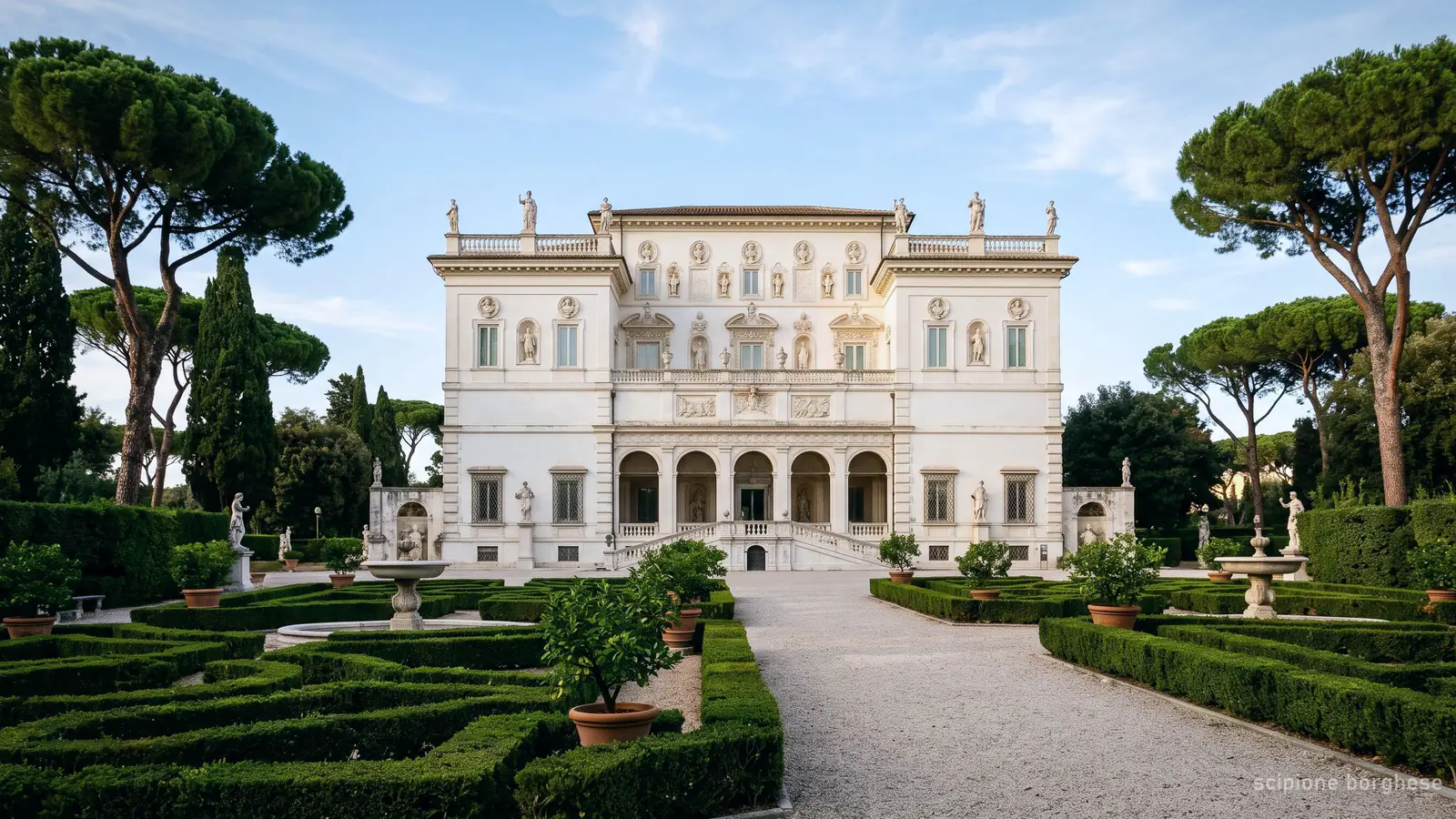
Building the villa
The villa stands “outside Porta Pinciana”, on land the family kept adding to until it formed a huge park. According to the museum:
- 1607: construction begins.
- To 1613: the architect Flaminio Ponzio directs the work.
- After 1613: Giovanni Vasanzio, the Flemish Jan van Santen, completes it. Wikipedia dates his commission to 1613-1615.
- 1617-1619: the aviary is built.
- 1620: the gardens are laid out.
The model was the 16th-century suburban villa, like the Farnesina and Villa Medici. Projecting wings joined by a portico kept the building light, and the facade was covered with ancient reliefs and statues as a preview of the treasures inside. In the museum’s words, it was a place of art and pleasure.
From family villa to state museum (1902)
- 1770s-1780s: Prince Marcantonio IV Borghese has the villa redecorated under the architect Antonio Asprucci. Painters and sculptors fill the rooms with the ceilings you see today, each room themed around its central statue.
- 1807: Napoleon forces Prince Camillo Borghese to sell the ancient sculptures. The Borghese Gladiator and Vase are still in the Louvre.
- 19th century: the family refills the rooms with other antiquities, and Canova’s Pauline Bonaparte arrives in 1838.
- 1892: the state buys the first works sold by the family, including the two busts of Scipione.
- 1902: the Italian state buys the villa and its collection.
- 1908: the state buys back the Rape of Proserpina from the Ludovisi heirs.
Today the gallery has 20 frescoed rooms on two floors: sculpture on the ground floor, paintings upstairs.
Seeing his collection on your visit
Every visit is a timed two-hour slot, with entry at the start of each hour and booking required for all tickets. The official ticket costs €18 (€16 + €2 booking fee), about $20, non-refundable. Guided tours from $55 and reserved-slot tickets from $46 are on the tickets and tours page.
When you’re ready to book, start with how to visit the Borghese Gallery: hours, slots, tickets and what each floor holds.
Check prices & dates
Book your tickets in advance: popular time slots sell out.
Book Borghese Tickets
From$44per person
Check availability- Free cancellation up to 24h on every ticket listed
- Reserve now, pay later
- Official price shown alongside
Frequently asked questions
Who was Cardinal Scipione Borghese?
Scipione Caffarelli Borghese (1577-1633) was the nephew of Pope Paul V, who made him a cardinal in 1605. As cardinal nephew he ran much of the papal government until 1621, and he used his wealth to build the Villa Borghese and its collection.
How did Scipione Borghese become so rich?
Through the offices and church revenues his uncle the pope gave him. Wikipedia puts his income at about 90,000 scudi in 1609, rising to about 140,000 scudi by 1612.
Who built the Villa Borghese?
Work began in 1607 under the architect Flaminio Ponzio, who ran it until 1613. The Flemish architect Giovanni Vasanzio (Jan van Santen) finished it. The aviary followed in 1617-1619 and the gardens in 1620.
When did the Borghese Gallery become a state museum?
The Italian state bought the villa and the collection in 1902. Wikipedia gives 1903 as the year the gallery was established.
Where is Scipione Borghese buried?
In the Borghese chapel of the basilica of Santa Maria Maggiore in Rome.
Sources