
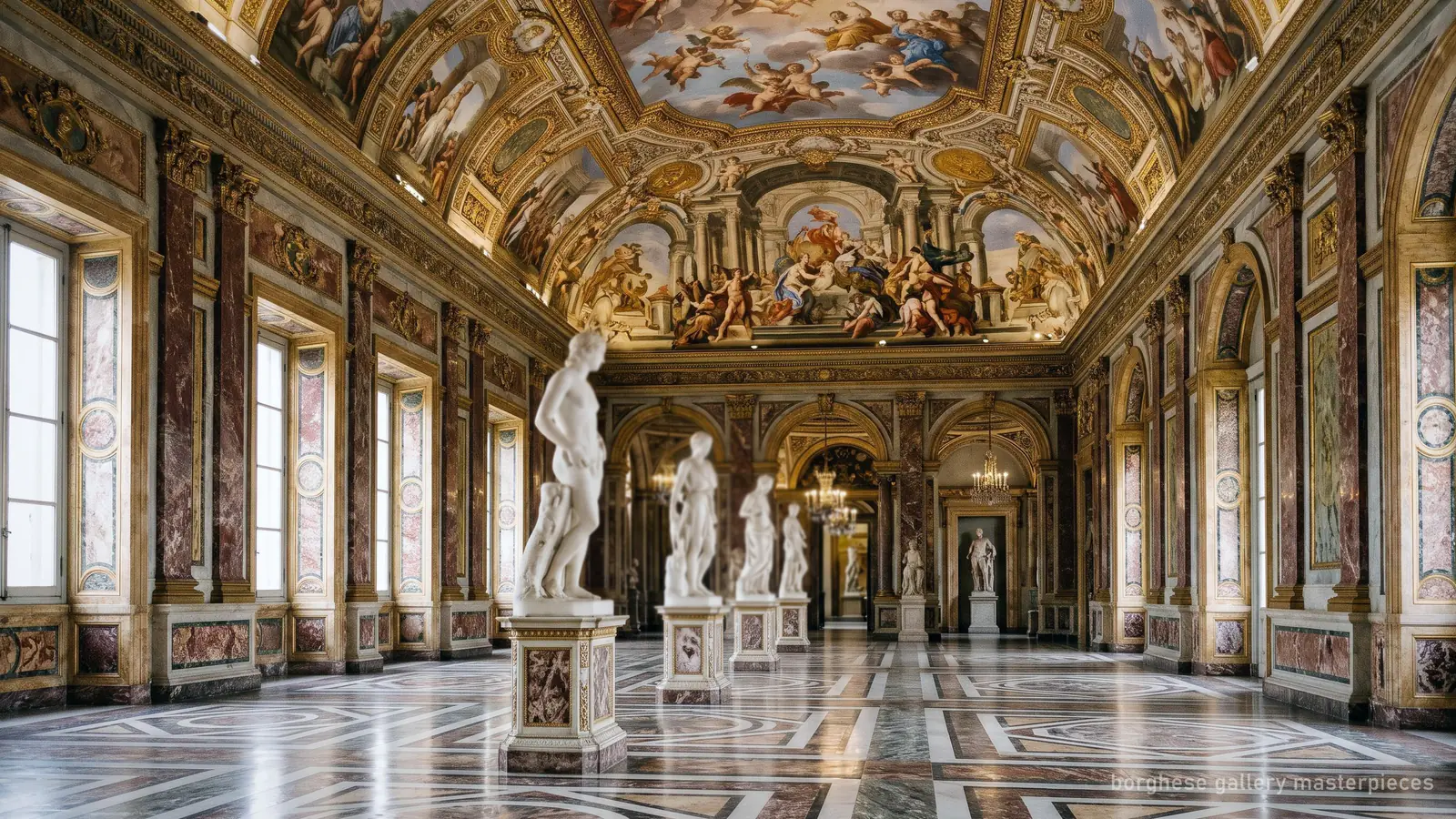
Borghese Gallery Masterpieces: What to See in Two Hours
Updated October 27, 2026
The Borghese Gallery masterpieces are Bernini's marble groups (Apollo and Daphne, David, The Rape of Proserpina), Canova's Pauline Bonaparte, six paintings by Caravaggio, and Raphael's and Titian's paintings upstairs. The museum has 20 frescoed rooms on two floors: sculpture on the ground floor, the picture gallery (Pinacoteca) on the first floor. Your timed slot lasts two hours, so the order matters. Spend about the first hour on the ground floor, Rooms 1 to 8, where the Bernini sculptures and the Caravaggios are. Then take the stairs to the first floor for Raphael's Deposition, Correggio's Danaë and Titian's Sacred and Profane Love in Room 20. Entry is at the start of the hour, so arrive before your slot opens.
- #1
Apollo and Daphne, Gian Lorenzo Bernini (Room 3)
Daphne turns into a laurel tree as Apollo catches her, in marble.
Bernini carved it between 1622 and 1625 for Cardinal Scipione Borghese, from the story in Ovid's Metamorphoses. It stands 243 cm tall. His assistant Giuliano Finelli worked on the finest details: the leaves and twigs growing from Daphne's fingers and her hair. Bernini meant it to be seen from the side, from the doorway where it first stood; it now sits in the middle of the room, so walk all the way round. Our artwork guide covers the story and the details to look for.
- #2
David, Gian Lorenzo Bernini (Room 2)
David caught mid-twist, a split second before he lets the stone fly.
Made in 1623–1624, in the middle of the work on Apollo and Daphne. Donatello's and Verrocchio's Davids show the victory and Michelangelo's the moment before battle; Bernini's shows the throw itself, the face frowning and biting its lower lip. His early biographers say Maffeo Barberini, later Pope Urban VIII, held a mirror so Bernini could model the face on his own. The room is named after it.
- #3
The Rape of Proserpina, Gian Lorenzo Bernini (Room 4)
Pluto's fingers press into Proserpina's thigh as if the marble were skin.
Carved in 1621–1622, when Bernini was 23, for Cardinal Scipione Borghese; 255 cm tall. Scipione gave it away in 1622 to Cardinal Ludovico Ludovisi, and it only came back in 1908, when the Italian state bought it and returned it to the gallery. It stands in Room 4, the Room of the Emperors.
- #4
Pauline Bonaparte as Venus Victrix, Antonio Canova (Room 1)
Napoleon's sister, reclining as Venus, apple in hand.
Canova made it in white marble in Rome from 1805 to 1808, commissioned by her husband, Camillo Borghese. The apple recalls Venus winning the Judgement of Paris. The wooden base once held a mechanism to turn the sculpture so viewers could see it from every side. It gives Room 1, the Paolina Room, its name, and is usually the first masterpiece you meet.
- #5
The six Caravaggios (Room 8, the Silenus Room)
Six Caravaggio paintings hang together in one room.
Room 8 holds six paintings by Caravaggio: Boy with a Basket of Fruit and Young Sick Bacchus (both about 1593), Saint Jerome Writing (about 1605–1606), Madonna and Child with Saint Anne (Dei Palafrenieri, 1605–1606), David with the Head of Goliath and Saint John the Baptist (both about 1610, the last years of his life). The head of Goliath is widely read as a self-portrait. Room 8 is the last on the ground floor, so keep time for it before going upstairs.
- #6
Sacred and Profane Love, Titian (Room 20)
Two women at a fountain: one clothed, one nude, and five centuries of argument about what they mean.
Painted probably in 1514, 118 x 279 cm, and believed to have been commissioned by Niccolò Aurelio, a secretary to the Venetian Council of Ten, for his marriage to Laura Bagarotto. Cardinal Scipione Borghese bought it in 1608. The title is first recorded only in 1693, so it may not be what Titian intended. Room 20 was closed until 16 October 2026 to install the exhibition Titian. Dialogues between Sacred and Profane.
- #7
The Deposition, Raphael (first floor)
Raphael's altarpiece of Christ carried to the tomb, painted in about 1507.
Commissioned by Atalanta Baglioni for her family chapel in San Francesco al Prato, Perugia, in memory of her murdered son, it was removed by force in 1608 by men working for Cardinal Scipione Borghese. It hangs in the first-floor picture gallery, where Room 9 also holds Raphael's Young Woman with Unicorn (about 1505).
- #8
Danaë, Correggio (Room 10)
Cupid undresses Danaë as Jupiter arrives as a shower of gold.
Painted in about 1531. Correggio's Danaë hangs in Room 10, the Hercules Room, among works by 16th-century Mannerist painters such as Parmigianino's Portrait of a Man. It is on the first floor, a short walk from the Raphael rooms.
- #9
Aeneas, Anchises and Ascanius, Gian Lorenzo Bernini (Room 6)
Bernini's first large marble group: three generations fleeing burning Troy.
Carved in 1618–1619, when Bernini was still in his teens or just out of them. Aeneas carries his father Anchises on his shoulder while his son Ascanius follows. Seen before Proserpina and Apollo and Daphne, it shows how fast Bernini's carving changed in a few years.
Frequently asked questions
What are the most famous works in the Borghese Gallery?
Bernini's Apollo and Daphne, David and The Rape of Proserpina, Canova's Pauline Bonaparte as Venus Victrix, six Caravaggio paintings in Room 8, Titian's Sacred and Profane Love and Raphael's Deposition.
Can you see the Borghese Gallery masterpieces in two hours?
Yes. Every timed slot lasts two hours (the 5.45 pm slot lasts 1 hour 15 minutes). Spend about an hour on the ground floor, Rooms 1 to 8, for Bernini, Canova and Caravaggio, then about an hour upstairs for Raphael, Correggio and Titian.
Where are the Caravaggios in the Borghese Gallery?
In Room 8, the Silenus Room, on the ground floor. It holds six paintings, from Boy with a Basket of Fruit (about 1593) to David with the Head of Goliath (about 1610).
Which room is Apollo and Daphne in?
Room 3, the Apollo and Daphne Room, on the ground floor. Bernini's David is next door in Room 2 and Canova's Pauline Bonaparte in Room 1.
Is the Borghese Gladiator in the Borghese Gallery?
No. Napoleon forced Camillo Borghese to sell the ancient sculptures in 1808, and the Borghese Gladiator is now in the Louvre in Paris. The rooms were refilled with other ancient works in the 19th century.
Can I take photos of the masterpieces?
Yes, for personal use, without flash, tripods or stands, per the museum's rules. Photography can be restricted during temporary exhibitions with loaned works.
Sources